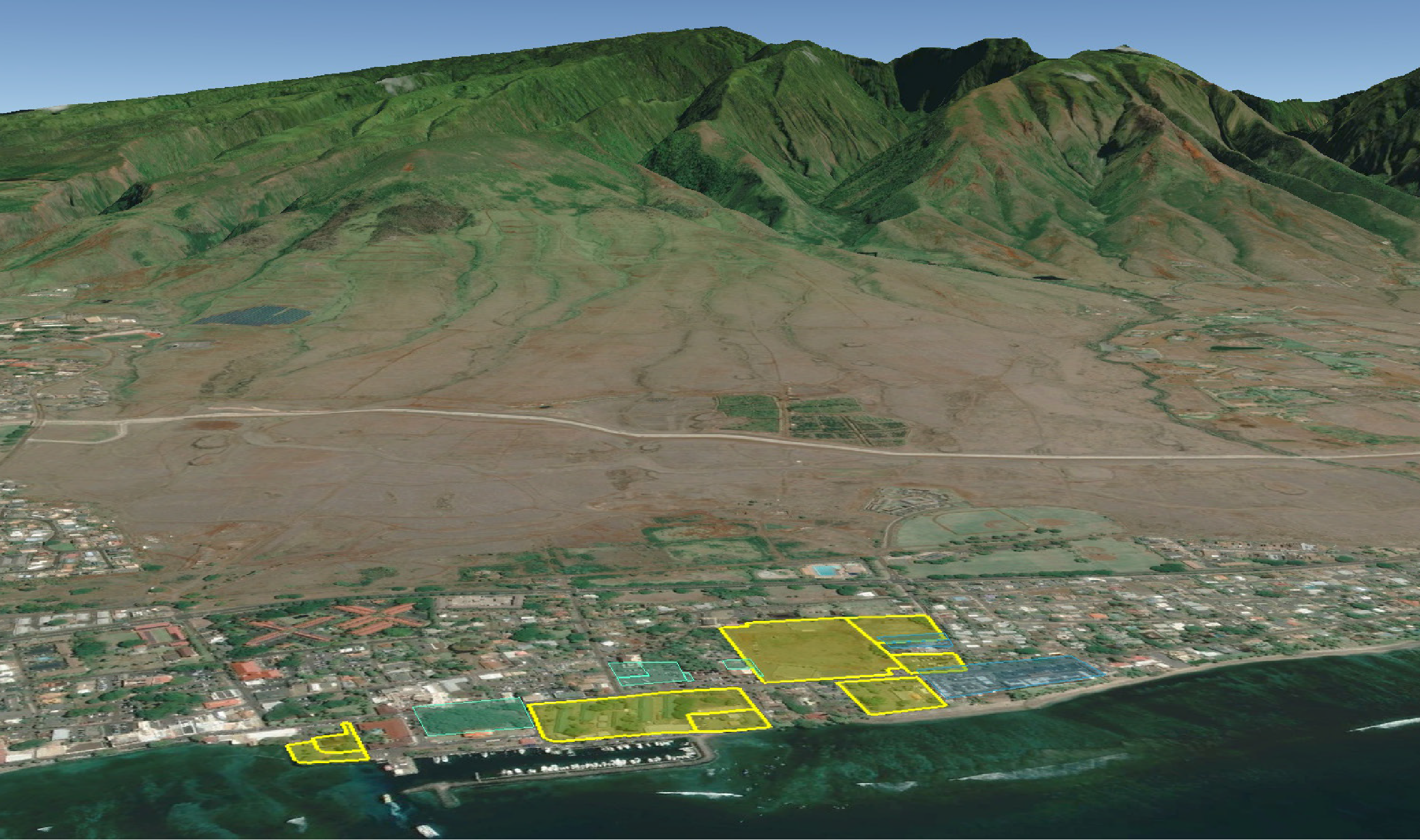
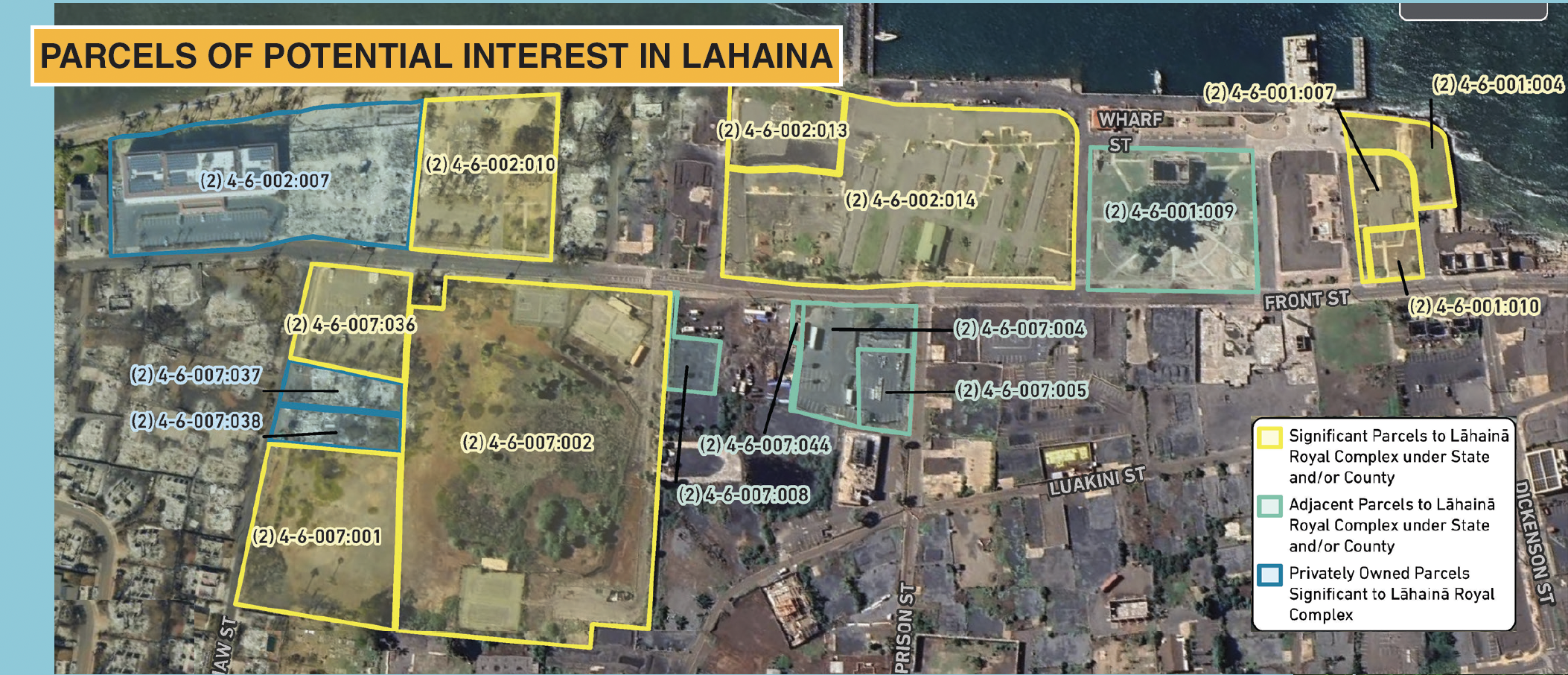
This project includes the creation of a cultural corridor and the restoration of Malu 'Ulu o Lele, Moku'ula and the Loko o Mokuhinia Complex. Collaborating closely with cultural practitioners, community organizations and technical experts, the County Department of ʻŌiwi Resources will lead the multiyear effort to guide post-fire recovery at King Kamehameha III’s Royal Residential Complex, or Lahaina Royal Complex.
Milestones:
The County of Maui Department of ʻŌiwi Resources is currently working with Group 70 International, Inc. (G70) to develop the Lahaina Royal Complex Master Plan.
July 2025: The Dept. of ʻŌiwi Resources launches master planning process
December 2025: The Dept. of ʻŌiwi Resources receives award of $2 million in grant funding from National Park Service FY25 Emergency Supplemental Historic Preservation Fund to advance planning and implementation.
Project Location:
The recovery project location on the map may not necessarily reflect the exact location of the recovery efforts but rather a representation of the area being serviced
“We have a unique opportunity to build back Lahaina in a way that showcases its history, working to restore Moku’ula. We should be looking to our past for the answers to our future, where you remember that it was once a lush paradise referred to as ‘the Venice of the Pacific’.”
Community Quote from Long-Term Planning Recovery Survey
The Lahaina Royal Complex Master Plan will create a comprehensive community vision for the spaces and ‘āina that comprise the Royal Complex. It will weave together cultural and historic sites, surrounding parts of the town, educational and recreational activities, parking, access, and movement around the area.
THE AREA
The Lahaina Royal Complex, also known as Lua‘ehu, encompasses the area of Moku‘ula, Loko O Mokuhinia, Pākalā, Loko O Nālehu, and many other significant sites surrounding the area formerly known as Malu ‘Ulu o Lele Park. The area was once the political capital of the Hawaiian Kingdom, the home of many of Maui’s and Hawai‘i’s greatest rulers and sacred spaces.
THE PROCESS
The Master Plan will combine the deep knowledge and lived experiences of the community with technical expertise, in-depth research, and thoughtful analysis to inform a comprehensive vision for the Royal Complex.
THE TIMELINE
The entire planning process—including technical studies, community engagement, and plan development—began in July 2025 and is currently anticipated to take two years.
THE TEAM
G70, the project lead, brings architectural and engineering services to the project and oversees a team of diverse capabilities that reflects the complex and multifaceted needs of the Master Plan process:
‘Āina Archaeology
AECOS
Dudek
Fehr & Peers
Geolabs Inc.
Hawai‘i Wildfire Management Org.
Intera
Kahālāwai Consulting
SR Partners
Umemoto Cassandro Design
For more information, please email LRC@g70.design. We welcome your mana‘o!
Frequently Asked Questions
Q: What is the Lahaina Royal Complex MasterPlan project?
A: The Master Plan project will create a comprehensive community vision for the spaces and ‘āina that comprise the Lahaina Royal Complex. It will weave together cultural and historic sites, surrounding parts of town, educational and recreational activities, parking, access, and movement around the area.
Q: What is the Lahaina Royal Complex?
A: The Lahaina Royal Complex, also known as Lua‘ehu, encompasses the area of Moku‘ula, Loko o Mokuhinia, Pākalā, Loko o Nālehu, and many other significant sites surrounding the area formerly known as Malu ‘Ulu o Lele Park. The area was once the political capital of the Hawaiian Kingdom, the home of many of Maui’s and Hawai‘i’s greatest rulers and sacred spaces.
Q: What is the value of this Master Plan?
A: The Master Plan process combines the deep knowledge and lived experiences of the community with technical expertise, in-depth research, and thoughtful analysis to inform one of the most complex planning processes in Maui County’s history. This shared vision positions the County to attract partners and funding to bring the Lahaina Royal Complex to fruition.
Q: What is the process for developing the Lahaina Royal Complex Master Plan?
A: The process for developing the Master Plan includes gathering community input throughout the process, exploring case studies that examine stewardship and management models of other heritage sites, conducting research to better understand historical and current conditions, examining stewardship and management models of other heritage sites, and building on concurrent planning efforts conducted by the County and community-based organizations.
Q: What is the timeline for completing the Master Plan?
A: The master planning process launched in July 2025 and is currently expected to take two years to complete.
Q: Why is the Lahaina Royal Complex Master Plan being done now?
A: The 2023 fires stimulated a renewed push for the revitalization of these sacred areas for the healing and recovery of the Lahaina community and entire lāhui. As a result, social, cultural, economic, and political forces have converged and are committed to the Plan’s development and execution.
Q: How does the Lahaina Royal Complex Master Plan relate to County priorities?
A: The West Maui Community Plan (We are Lahaina) calls for the restoration of Moku'ula and Mokuhinia Pond and the incorporation of this policy in any future master planning process for the area. The Lahaina Long-Term Recovery Plan through extensive community feedback, identified the Lahaina Royal Complex Master Plan and the restoration of the Moku'ula and Loko o Mokuhinia Complex as long-term priorities important to Lahaina residents. The Lahaina Royal Complex Master Plan is the beginning of the implementation of these County Priorities.
Q: How much is the Lahaina Royal Complex Master Plan going to cost and who is paying for its development?
A: The budget for the plan is $1 million from the County of Maui Office of Recovery FY 25 budget and the master planning process is being led by the County of Maui Department of ‘Ōiwi Resources.
Q: What happens after the Master Plan is done?
A: The Master Plan report will include a phased implementation plan with a timeline and milestones. The Lahaina Royal Complex Master Plan itself does not trigger or involve any permitting or regulatory actions; however, once the Master Plan is approved by the Department of ‘Ōiwi Resources, implementation may involve various review and approval processes.
Q: Who is on the Lahaina Royal Complex Master Plan project team?
A: G70, the project lead, brings architectural and engineering services to the project, and will develop the Master Plan report in English and ‘Ōlelo Hawai‘i. The firm oversees a team of diverse capabilities that reflects the complex and multifaceted needs of the project:
‘Āina Archaeology on the cultural, historic, and archaeological resources.
AECOS on the biology of wetlands, the feasibility of restoration, and the flora and fauna.
Dudek on the boundaries and topography.
Fehr & Peers on traffic and circulation.
Geolabs Inc. on geology and soils.
Hawai‘i Wildfire Management Organization on natural hazards.
HeFenua as cultural liaison and protocol advisor and ‘Ōlelo Hawai‘i translation.
Intera on hydrology, water resources, and the wetlands.
Kahālāwai Consulting on existing land, water use, and water resource regulations.
SR Partners for community engagement and outreach.
Umemoto Cassandro Design for landscape planning.
Q: How can I get involved in the Master Plan process?
A: You can get involved in multiple ways, including upcoming small group sessions, open houses, and surveys. If you would like to participate, please contact our team by the phone number or email address listed below.
Q: How can I find out more about the Master Plan process?
A: The project website will be launched soon. Information provided will include the project description, maps and references, milestones and updates on the Master Plan process, opportunities for public participation, team members, and contact information.
Lahaina Royal Complex Master Plan
The County of Maui Department of ʻŌiwi Resources is currently working with Group 70 International, Inc. (G70) to develop the Lahaina Royal Complex Master Plan. The project scope includes hydrology and water policy; wildfire resiliency and risk planning; biological and ecological assessment; cultural landscape architecture; community engagement protocol; transportation circulation planning; topographical survey; cultural and archaeological studies; soils and geotechnical studies; and boundary mapping.
Provide your comments on the draft Action Plan online, by mail or in-person at the Lahaina Resource Center or Kāko‘o Maui Relief & Aid Services Center.
“We have a unique opportunity to build back Lahaina in a way that showcases its history, working to restore Moku’ula. We should be looking to our past for the answers to our future, where you remember that it was once a lush paradise referred to as ‘the Venice of the Pacific’.”
Community Quote from Long-Term Planning Recovery Survey
Purpose
Historically, Loko o Mokuhinia was a 17-acre pond among West Maui’s large network of coastal wetlands. Located within the pond was Mokuʻula, an island reserved for high ranking aliʻi. Mokuʻula and Loko o Mokuhinia were highly sacred and culturally significant spaces. In the mid-19th century, water diversions to large-scale plantations in West Maui led to the eventual stagnation of Loko o Mokuhinia. In the early 20th century, the pond was filled and turned into Malu ʻUlu o Lele Park, and today Mokuʻula and Mokuhinia lie about 2 to 3 feet underground. The Native Hawaiian community and broader local community have been fighting for the restoration of Mokuʻula and Mokuhinia for decades. The 2023 Lahaina wildfires stimulated a renewed push for the revitalization of Mokuʻula and Mokuhinia for the healing and recovery of the Lahaina community and lāhui.
Project Description
This project includes the creation of a cultural corridor and the restoration of Malu ʻUlu o Lele, Mokuʻula and the Loko o Mokuhinia Complex. A cultural corridor along the coast will restore, honor and protect culturally significant sites from Mokuʻula to the King’s Loʻi Kalo—including other sites such as, Loko o Nalehu, Loko o Kaluaʻehu and Hale Piula. Restoration of the three areas will create a sustainable and vibrant cultural space that remembers and highlights Hawaiian history, restores Lahaina’s natural wetland coastal ecosystem and cultural historical sites, supports the well-being of the Lahaina community, and, with the planting of ‘ulu trees throughout Lahaina, reduces urban heat index and provides a potential food source for generations to come. Benefits of this project include community healing, wetland and habitat restoration, restoration of Native Hawaiian places of historical and spiritual significance, flood mitigation and control, fire risk mitigation through green breaks and water breaks, increase in water flow and groundwater recharge, and a buffer between the ocean and the town to mitigate hazards of sea level rise, shoreline erosion and waves.
Interdependencies and Roadblocks
Restoration of the Lahaina Royal Complex will require collaboration and communication between the community and government agencies across County, State and federal levels. Restoration will require several years for planning and implementation, so funding needs will be ongoing. Additionally, restoration will have interdependencies with other recovery efforts like the reconstruction of the town, watershed restoration and water and stream flow, so timing and coordination will be key in the planning phase.


.svg)
.svg)
.jpg)